When Jesus healed the leper and commanded, “Go, show yourself to the priest,” He was doing far more than honoring an ancient ritual. He was revealing something profound about the way God restores His people. As God, Jesus could have changed the old law, but He kept it for a great reason, it aided true and complete healing. In Israel, leprosy was not merely an illness; it was a wound that fractured a person’s place in the community. The priest did not have the authority to cure the disease, his role was to verified healing, performed the rites of cleansing, and declared the person restored to the worshiping life of Israel. Jesus’ command was an act of mercy, ensuring that the man’s healing was physically, spiritually, and socially complete.
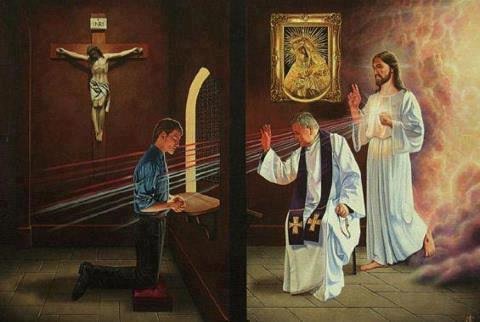
This moment foreshadows a deeper reality fulfilled in Christ Jesus. Just as leprosy isolated a person from the community, sin isolates the soul from communion with God, his neighbors, and with himself. Just as the healed leper needed a priest to declare him clean, the sinner needs Christ’s minister to reconcile him through the sacrament He Himself instituted, the Sacrament of Reconciliation. The Old Covenant priest could examine and declare; the New Covenant priest, acting in persona Christi, forgives, absolves, and restores the sinner.
Catholic Confession does not arise from the Levitical system but from the risen Christ’s explicit command: “Receive the Holy Spirit. Whose sins you forgive are forgiven them.” In that moment, Jesus entrusted His healing authority to His apostles, not to diagnose physical wounds, but to mend the deeper wounds of the mind, heart and soul. Through the sacrament of Penance, Christ continues His work of cleansing, not from ritual impurity, but from the spiritual leprosy of sin.
Yet the parallels remain powerful. The leper’s healing teaches us that God’s mercy is never merely internal. We were never meant to be an island. It restores us to communion, to mission, to life. Confession does the same. It is not simply a private moment of sorrow; it is a sacramental encounter where Christ lifts the mental burden of sin, renews Sanctifying Grace given to us in Baptism and lost due to sin, and returns us to the community of believers with a heart made whole. In Confession, the sinner does what the leper did: approaches with humility, submits to examination, offers what is required, and receives restoration.
This is why the Church speaks of Penance as a sacrament of healing. Sin creates wounds. Grace heals those injuries. And Christ, the Divine Physician, uses His ministers to apply the remedy. The priest does not forgive by his own power; he is the instrument through whom Christ speaks the liberating words: “I absolve you.” In that moment, the soul is cleansed more deeply than any ritual washing could ever accomplish.
The story of the leper reminds us that God’s mercy always moves toward restoration. Jesus heals what is broken, reintegrates what is isolated, and renews what sin has damaged. Confession is the continuation of that mission, a place where Christ touches the wounded soul, where grace flows like living water, and where the sinner rises renewed, restored, and ready to walk again in the freedom of God’s love.
With every absolution, the miracle of cleansing happens as it did two thousand years ago. Christ heals. Christ restores. Christ brings us home.
If this is my last post, I want all to know, there was only one purpose for all that I have written; to have made a positive difference in the lives of others.
Anthony “Tony” Boquet, Solutionary, author of “The Bloodline of Wisdom, The Awakening of a Modern Solutionary” and “The Passion, Death, and Resurrection of Jesus Christ, a Devotional Timeline”