Every word has a birthplace, but only a few have a destiny. Solutionary is one of those rare words, born quietly, nurtured slowly, and then guided into its true purpose by those who recognized its potential to elevate human thinking. Its story is not just linguistic; it is generational. It began with the parent and continues with its mentor.
In the early 1990s, educator Zoe Weil first breathed life into the term Solutionary. She used it in her humane education work, describing individuals who sought compassionate solutions to global problems. Like many new words, its infancy was private. It lived in classrooms, workshops, and internal materials, unpublished, unindexed, and unseen by the wider world. Zoe was the parent of the word, giving it its first heartbeat, its first meaning, and its first home.
But a word’s birth does not guarantee its future. Many words never leave the cradle. They remain small, local, and limited. Solutionary might have been one of them, until it met its first mentor.
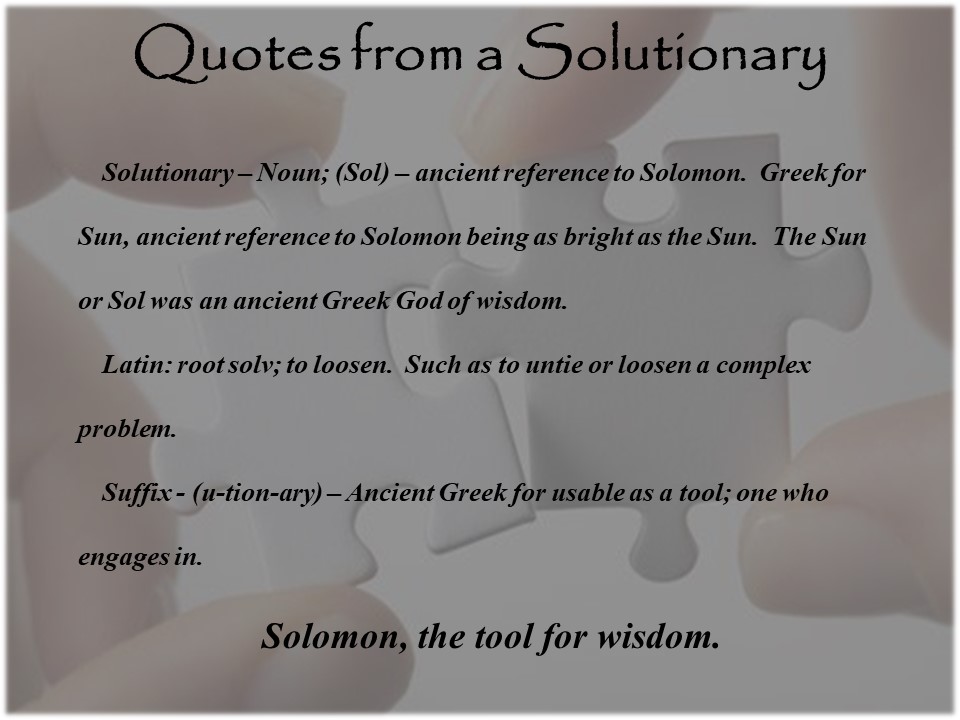
In 2009, unaware of Zoe’s early use, I searched for a word to replace my long-held title as a problem-solver and finding none, I creatively crafted a play on visionary, but for problems. Searching the web, I found zero digital trace of the term, I adopted the word independently. Placing it on my LinkedIn profile, I began I incorporated it in my public lectures and wove it into his leadership teachings. Five years later, doing research for my first book, I discovered its unique tie to ancient Greek. I saw in the word something larger, something timeless, something rooted not only in compassion but in wisdom. I became a mentor of Solutionary, the one who took the young word by the hand and guided it into the world of ideas, philosophy, and human development.
Where Zoe gave the word life, I gave it direction.
Drawing from the wisdom principles of King Solomon, the first living Solutionary, I expanded the term into a structured identity. A Solutionary became someone who uses discernment of the truth, moral clarity, and selfless mindset to help others solve their problems. No longer just an ethical problem-solver, the Solutionary became a leader, a guide, a servant of unity, and a builder of wise decision making.
In 2015, I published “The Bloodline of Wisdom, The Awakening of a Modern Solutionary”, marking the earliest formal, commercial uses of the word in print. With that book, the term stepped out of childhood and into maturity. It gained definition, philosophy, and purpose. It became a vocation.
Today, the word Solutionary carries the influence of both its parent and its mentor. Zoe Weil gave it its first breath. I gave it its first direction. Together, unknowingly, independently, they shaped a term that now inspires leaders, educators, thinkers, and everyday citizens to rise above conflict and become wise guides for others.
The birth of Solutionary was quiet. Its development was steady. Its future is powerful. And like all meaningful words, it continues to grow through those who choose to live its meaning.
If this is my last post, I want all to know there was only one purpose for all that I have written; to have made a positive difference in the lives of others.
Anthony “Tony” Boquet, Solutionary, author of “The Bloodline of Wisdom, The Awakening of a Modern Solutionary” and “The Passion, Death, and Resurrection of Jesus Christ, A Devotional Timeline”