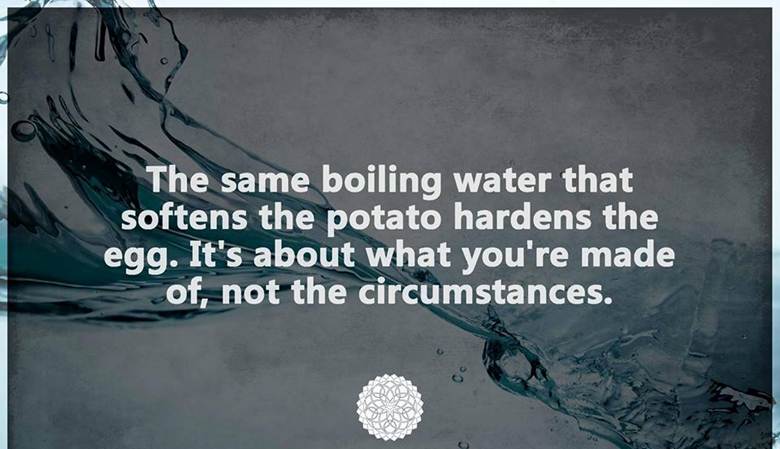
You have most likely heard, saw, or even used the quote above. The analogy is mainly focused on the reactions of two different individuals. It is inferred that when facing the same adversity, one person will react one way, while another completely the opposite. The reasoning is simple, the person we have become will react a certain way and someone with varied education, experiences, and moral / ethical values will respond completely differently. This is a great analogy and is completely true because our education, experience, and values forge us into who we are but there are other issues in play here.
What about the three outside factors, and the people who can regulate them?
The egg and potato are both acted upon by three different factors; the force (heat) applied to the environment (the pot of water), and the time exposed causing the transformation. Once again, we find the Power of the Wisdom of Three influencing our lives as well as those who lead us. The surroundings of every object matter. A pot of water heats differently than one filled with rocks. Heat is the force mentioned but there are many different forces that can affect change. We see this in almost every scientific change known to man. In this example, apply too much heat, the substance being worked on will be ruined; too little may show very little impact. Varied substances will naturally react differently under the same forces. The same temperature of one hundred and twelve degrees Fahrenheit applied to a rock and a marshmallow will yield different results; the rock will get warm to the touch, but the marshmallow will melt into an unrecognizable blob. Finally, time plays a vital role in the level of change experienced. Time can be a guiding factor to the level of change desired. In the marshmallow example above, exposure to boiling water for a second will yield a lesser impact than ten minutes would.
What about those who lead us? How do they fit into this analogy?
It is the leader who is usually charged with harnessing, controlling, or regulating the three factors their followers are exposed to; they can control the end results; however, the leader must never confuse controlling the results with controlling the environment, force, or time exposed. The leader has limited authority over the forces, in the best of circumstances, and even less at the worst of times. The egg and potato are definitely affected by these three factors, but they were likely put into the situation by someone who desired to use them in the best way possible. That someone can be said to be the leader.
A good leader, who knows their people, should be the one to choose the best environment for them to grow. Understanding their make up; who they were, who they are, and who they wish to be. Whether the players are aware or not, they all change; some will make positive changes, others negative, and a few will change in an ineffective manner. The very best leaders, with the agreement of the associate, will place their people into situations that encourage positive change. The situations and the person must be well matched for this to happen. When mistakes are made, and they will be made, the associate must be guided to a new path; an environment more suitable to them. The environment should challenge the person and continue to change with the person. This is the only way to see continued positive growth.
A good leader will then regulate the amount of “heat” or forces the individual is subjected to. They will want the “temperature” to rise slowly so as not to burn the individual. Each team member will be affected differently based on their education, experience, and moral / ethical behaviors. What may be considered extreme for one may be minor for another. A leader must keep their hand on the thermostat at all times. When a team is doing well, the heat should be elevated so as to take advantage of the surrounding climate. Teams can take more pressure when things are good and less when circumstances are out of their control. When a team member is going through tough times not of their making, the individual’s heat must be lowered so as to relieve unnecessary tension. Then, as things settle down, the intensity of the heat might have to be increased slowly, or a different force might need to be introduced. If the two are communicating well, the levels can be adjusted quickly with great results. When communication is weak the results are much harder to monitor and adjust.
Finally, the time element must be set, measured, and adjusted accordingly. As changes occur, timing will dictate when we must move someone from one environment to another. It might take one person a year to fully develop, two years for another, and a third might need to be let go quickly because they are not cut out for the environment or the forces they must deal with. In some cases, the person’s education, experience, and beliefs will clash with one or more of the factors needed for success. This is okay and natural. Not everyone will be willing and able to excel in certain factors. Timing is a critical force in the leader’s toolbox and should never be squandered by the emotions of the teammate or the leader. To recap, environment, force, and timing; three important factors in the transformation of a person. The leader, guardian, or mentor can and should be the one regulating each; with the blessing of the associate. Remember, regulating them does not mean the leader has the power to control them. There are many environments and forces outside of human control. We can understand them, we can use them, and we can regulate exposure to them, but never fully control them. When we start trying to control things that we have no power over we begin to lose the battle with reality. The same can be said about change. We can desire to see a positive change in others, but we can never change them ourselves. We can make it easier for them to change themselves, but we have never had the power to change anyone other than ourselves. The pressure people encounter, the person they wish to become, and the timing of their lives are all a byproduct of a lifetime of education, experience, and moral values. Someone else can have an impact on these moving forward but the level of impact is based on a multitude of unknowns, many of which happened many years in their past. All parties involved can only strive to do three things; do what is right, do the best they can, and treat others the way they wish to be treated.
If this is my last post, I want all to know there was only one purpose for all that I have written; to have made a positive difference in the lives of others.
Anthony “Tony” Boquet, Solutionary, author of “The Bloodline of Wisdom, The Awakening of a Modern Solutionary” and The Passion, Death, and Resurrection of Jesus Christ, A Devotional Timeline”