Ancient and Cultural Origins
Veiling predates Christianity by millennia. Elite women in ancient Mesopotamia donned veils around 1400 BC to signal status; Greek matrons embraced the practice by 550 BC, and Roman wives covered their heads as a public mark of marital dignity. Jewish women adopted veils as signs of modesty and ritual purity, a custom hinted at in Genesis 24:65 when Rebekah veiled before Isaac. As Christianity emerged in a Jewish and Greco-Roman world, it inherited this rich tapestry of meaning, transforming veils into potent symbols of reverence and spiritual dedication.
Scriptural and Patristic Foundation
St. Paul’s directive in 1 Corinthians 11:4 – 16 anchors the practice in divine order: “a woman should have a veil upon her head…for a man ought not to cover his head”. Early Church Fathers like Tertullian and Clement of Alexandria interpreted this veiling as participation in the heavenly liturgy, likening it to angels who veil their faces before God’s throne. The veil thus embodied both gendered symbolisms, reflecting Christ’s headship of the Church, and cosmic worship, reminding women of their call to imitate Mary’s humble modesty and obedience to God.
Medieval Continuity and Codification
By the Middle Ages, veiling had become universal in Western Christendom. The 1917 Code of Canon Law formally required women to cover their heads at Mass, and ecclesiastical manuals prescribed lace mantillas or simple cloths. These veils, often called chapel veils, mirrored the tabernacle’s veil, signaling that the Mass is a foretaste of the heavenly banquet. For centuries, every bride, religious woman, and laywoman entered church under a veil, reinforcing the sacred character of public worship.
Post-Vatican II Decline
After the Second Vatican Council (1962–65), the 1983 Code of Canon Law omitted the head-covering mandate “without explanation,” and veiling rapidly waned in most parishes. The shift reflected a broader liturgical and cultural turn toward simplicity and modernization. By the late 20th century, veiled women at Mass were a rarity outside traditionalist chapels or devout enclaves, and younger generations often viewed the practice as antiquated or even oppressive.
Revival Among Millennials
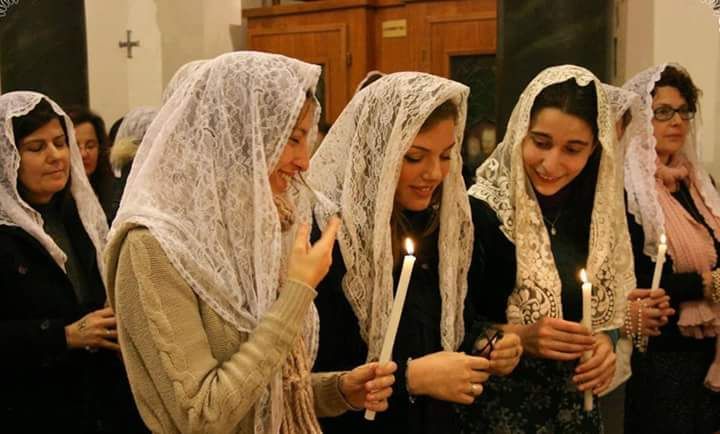
Now, something amazing is happening, and without Church directives. In recent years, a surprising resurgence has taken root among millennial Catholics. Drawn to both the Traditional Latin Mass and a thirst for visible devotion, many young women have rediscovered the veil’s beauty and symbolism. Online shops now abound with lace mantillas, and social media influencers share styling tips and theological reflections. For them, the veil is not a symbol of subjugation but a voluntary sign of humility, modesty, and unity with the “Bride of Christ”.
Here are a few recent examples of people included in this shift back to the veil.
A Mother-Daughter Journey
Sarah Damm recounts how, during Lent 2023, she told her 17-year-old daughter she felt drawn to veil at Mass. To her surprise, her daughter had the same conviction. By Easter, both were wearing mantillas weekly. Their journey began with a deeper encounter with the Traditional Latin Mass and a desire to set aside distraction: “draping a veil became a “physical reminder” of entering sacred space and worshiping God on an intimate one on one perspective.”
A Counter-Cultural Witness
Steffani Jacobs, writing for Catholic Stand, describes the ridicule she faced among peers who saw veiling as sexist. Yet she embraced the veil as a “visual sermon,” proclaiming obedience to Christ in a culture of self-assertion. For Steffani, the veil’s true meaning shines when compared to the veiled tabernacle and altar: “if the dwelling place of Christ merits a veil, so too does a woman who bears His mother’s image and calls Jesus Lord.”
A Veil’s Enduring Message
Through two thousand years, Catholic women have veiled at Mass to express reverence, obedience, and participation in the heavenly liturgy. Whether in ancient courts or modern pews, the veil weaves together Scripture, tradition, and personal devotion, remaining a “visible act of modesty and humility” that proclaims the recognition of Christ’s real presence and the Church’s enduring identity as His home on earth.
If this is my last post, I want all to know there was only one purpose for all that I have written; to have made a positive difference in the lives of others.
Anthony “Tony” Boquet, a Modern Solutionary, Certified Professional Business Coach, and the author of “The Bloodline of Wisdom, The Awakening of a Modern Solutionary” and “The Passion, Death, and Resurrection of Jesus Christ, A Devotional Timeline”