
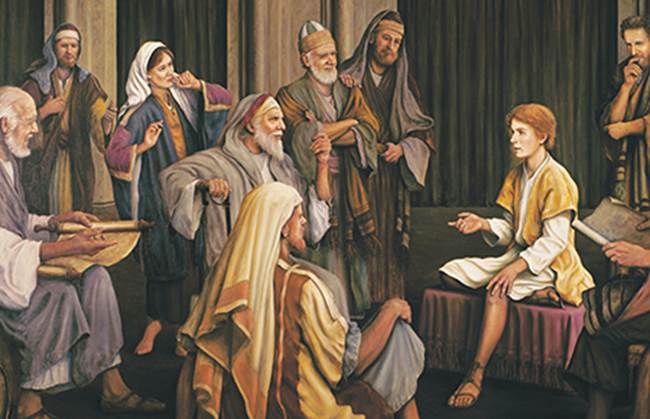
The Church teaches that, according to the law, Jewish males were commanded to appear before the Lord three times a year, for the feasts of Unleavened Bread (Passover), Weeks (Pentecost), and Tabernacles (Booths).
We are told, that when Jesus was twelve years old, His parents accidentally left Him behind in Jerusalem for three days. When they finally found Him, He was in the Temple, calm, confident, and fully at home, listening, asking questions, and astonishing the teachers with His understanding. On the surface, it seems like a simple family mishap. These things happen. Right?
Yes, it can happen to any family. But when we place this moment back into its historical and spiritual context, a deeper and more profound picture emerges, one that likely changed the lives of everyone who encountered that remarkable boy who would come of age, year by year, in their very presence. You see, at twelve years of age, Jesus could enter the Temple area and Synagogues as a man, and that ability began His introduction to the Jewish community.
None of the priests, rabbis, scribes, and pilgrims who interacted with the twelve‑year‑old Jesus could have imagined what the next twenty‑one years would bring. Some of those very men, young students, or seasoned teachers, would possibly later stand along the road a day or two before Passover, shouting praises as this familiar looking guy entered Jerusalem as the long‑awaited Messiah. Did they truly connect that once wise young boy to the observance of Jewish customs and His role as the “Anointed One”?
That same year, just a few days later, many of those same people could have been caught up along the crowded streets, this time weeping as they witnessed His bruised and beaten body paraded toward Golgotha. Their hopes of a triumphant Messianic reign short lived, as nails pierced His hands and feet. None of them foresaw the resurrection that would follow, yet every one of them, who through the years sat on the Temple steps listening to a pilgrim boy, who would become a carpenter, and eventually a rabbi would carry the memories of those encounters into their own adult lives.
Jerusalem’s citizens and the annual pilgrims were the first to encounter Jesus on multiple yearly visits, not only through His three years of public ministry, but through the quiet, consistent, presence of His yearly pilgrimages. For twenty‑one years, faithful Jewish pilgrims returned to the Temple for the feast days, and Jesus returned with them. His presence, first as a gifted child, then as a gracious young man, would have left an indelible imprint on their hearts. His messages carried power but were never forceful, never imposing. Until AD 30, when something changed. After He was baptized in the Jordan and returned from a forty day “desert retreat”. He selected apostles and replaced His carpentry tools with Scripture understanding and leadership skills. The fervor of His teachings became undeniable. His words were the truth spoken with confidence and love, used to forge a familiar relationship with God through peace and forgiveness. And still, the Jews never recognized God in their midst!
Think of our own life experiences. Have you ever attended a powerful presentation, heard an unforgettable song, or had a meaningful conversation that changed who you were? Now imagine a similar experience multiplied seven-fold repeated multiple times a year for over two decades, each encounter deepening the impact, each memory reshaping your character, each lesson preparing your heart for something greater.
During those hidden years, did people look forward to sitting by His side, three times a year? Of course they did; He is Jesus!
This is a deeply human way to connect two familiar biblical events: the boy Jesus in the Temple, attending His first Passover festival in AD 12 as an “adult male” and the thirty-three-year-old Jesus walking toward the Resurrection in AD 33, connected by twenty‑one years of normal life. Few people link these two stories in this way, yet they are beautifully intertwined. It is entirely possible that Jesus needed to be in the Temple at twelve, not only for His own mission, but to plant memories in the minds of the teachers of the Law and those of other pilgrims He encountered through the years. If their stories could have all been captured in writing, they would probably amaze us, but they are left to our imagination. Some of those same people may have even been present in the Sanhedrin during His trial. What I am pretty sure of, is that all who met and spoke with Jesus through those twenty-one years would have carried personal memories of that wise child who once schooled the teachers.
What an extraordinary “unknown” gift Jesus gave to the people of Jerusalem and the pilgrims He’d see on those visits between AD 12 and AD 33; moments that became memories, memories that became lessons, and lessons that became a lifelong transformation.
If this is my last post, I want all to know there was only one purpose for all that I have written; to have made a positive difference in the lives of others.
Anthony “Tony” Boquet, the author of “The Bloodline of Wisdom, The Awakening of a Modern Solutionary” and “The Passion, Death, and Resurrection of Jesus Christ, A Devotional Timeline”