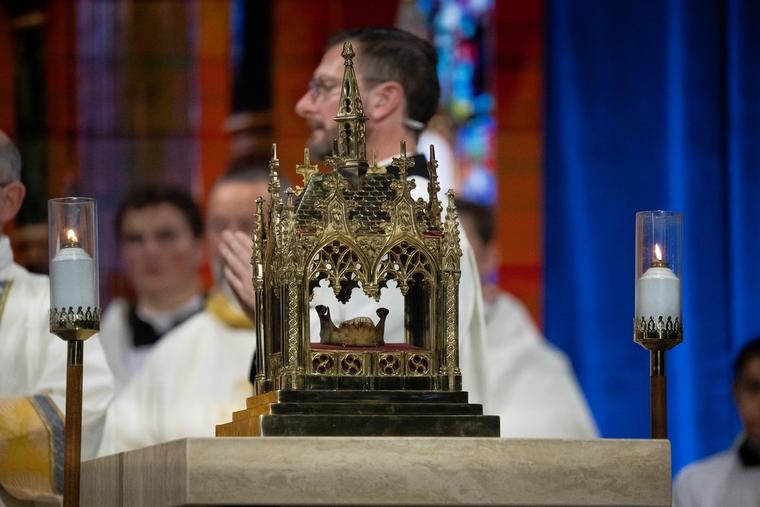
When Blessed Fulton J. Sheen’s jawbone was chosen as a first‑class relic, many outside the Catholic tradition wondered why the Church permits this practice yet forbids the scattering or dividing of ordinary remains. The answer lies not in superstition, but in theology, specifically, in the Church’s understanding of the human body and the communion of saints.
From the earliest centuries, Christians treated the bodies of martyrs and holy men and women with profound reverence. The catacombs of Rome bear witness to this devotion. Early Church Fathers such as St. Jerome and St. Augustine wrote that the remains of the faithful were not mere dust, but temples of the Holy Spirit, destined for resurrection. When believers gathered at the tombs of saints for Mass, they did so not to worship bones, but to honor the God who worked through those lives.
The Church’s teaching remains consistent: the body is part of the human person, not a disposable shell. In Baptism, the body is consecrated to God; in death, it awaits the promise of resurrection. That is why cremation, now permitted, requires that ashes be kept together in a sacred place, never scattered or divided among relatives. The unity of the remains expresses the unity of the person and the hope of eternal life.
Relics, however, are a regulated exception. They exist not for private possession but for public veneration under ecclesial oversight. A saint’s body, or sometimes a small portion of it, is preserved to inspire faith and remind the world that holiness is possible. The Church does not allow relics to be traded, scattered, or treated as curiosities. They are safeguarded as sacred witnesses to grace.
This distinction is crucial. The Church does not say that saints’ bodies may be divided while others may not. Rather, it recognizes that the veneration of relics serves a communal purpose: to draw believers toward Christ through the example of His faithful servants. The remains of the saint are not objects of power; they are signs of transformation. They proclaim that the same Spirit who sanctified the saint is at work in every believer.
For all Christians, Catholic, Protestant, or otherwise, the message is the same: the body matters. It is created by God, redeemed by Christ, and destined for glory. To treat it with reverence is to affirm the Gospel itself.
Fulton Sheen spent his life making Christ visible through word and witness. Even in death, his relic reminds us that holiness is not confined to history, it continues to speak. The Church’s care for his remains is not about possession, but proclamation: that every life lived for God becomes a beacon of hope for the world.
In honoring the saints, we honor the Savior who made them holy. And in respecting every individual body, we affirm the promise that one day, all who believe will rise again, whole, restored, and radiant in His presence.
If this is my last post, I want all to know, there was only one purpose for all that I have written; to have made a positive difference in the lives of others.
Anthony “Tony” Boquet, Solutionary, author of “The Bloodline of Wisdom, The Awakening of a Modern Solutionary” and “The Passion, Death, and Resurrection of Jesus Christ, a Devotional Timeline”